Arunachaleswarar, Tiruvannamalai: the temple of the fire lingam, Girivalam, and the Deepam on the hill
At four in the morning on a full-moon night, the road around the hill at Tiruvannamalai is full of people walking barefoot. Grandmothers with plastic bags of camphor. College students in groups. Foreigners from the ashrams with shawls over their heads. Nobody is in a hurry. Every few hundred metres a small shrine has its lamp lit, and the hill itself, Arunachala, sits dark and quiet on your right the whole way round.
In Tiruvannamalai the hill is not behind the temple. The hill is the deity, and the great temple at its foot is where you go to meet it up close.
The story of the place
The temple's tradition rests on a story from the Shiva Purana. Brahma and Vishnu argued about which of them was greater. A column of fire appeared between them, with no visible beginning or end, and they agreed that whoever found an end of it would win. Vishnu took the form of a boar and dug downwards; Brahma became a swan and flew up. Neither found an end. Vishnu came back and admitted it. Brahma claimed he had seen the top, and Shiva, who was the column of fire, rebuked him for the lie.
Tiruvannamalai's own tradition says that the column of fire became the hill of Arunachala, cooled into stone so that people could approach it. That is why the temple counts as the fire (Agni) lingam among the five Pancha Bhoota Sthalams, the five temples of Shiva linked with the five elements.
The temple's history page, from the Tamil Nadu government's temple department, adds a second story: Parvati did penance here and was united with Shiva on the full moon of Karthigai. That is the night the great lamp is lit on the hilltop.
The temple itself
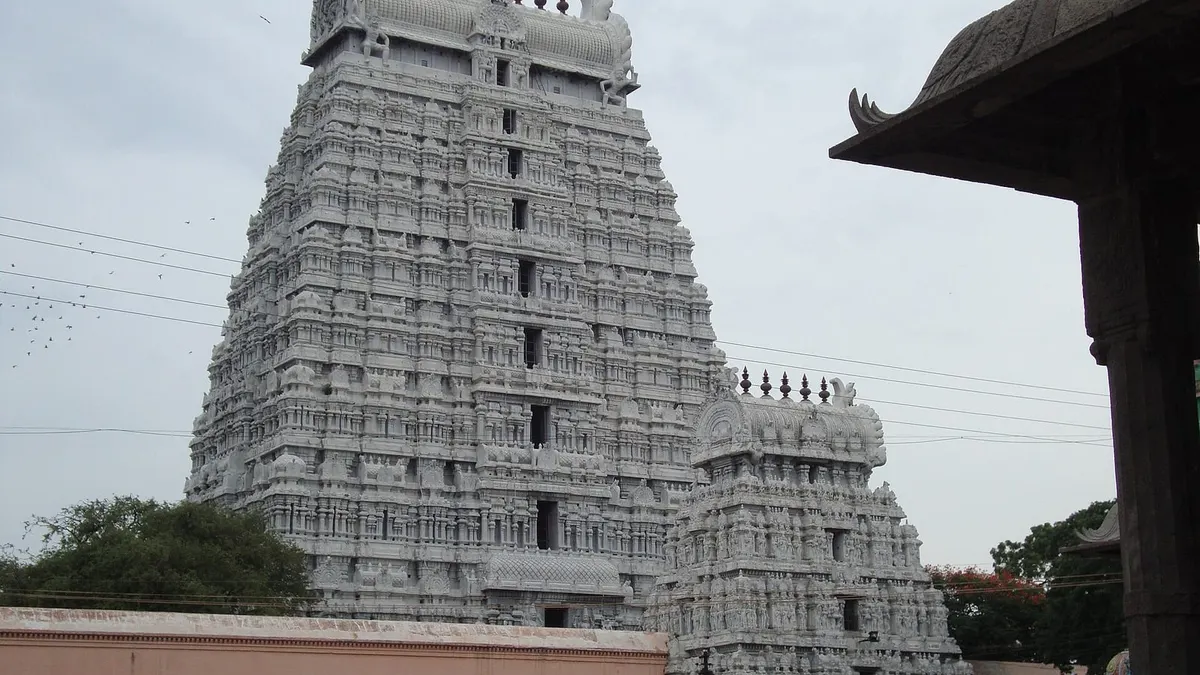
The complex covers about 25 acres, with four gopurams facing the four directions. The eastern Rajagopuram is about 66 metres high and has eleven storeys, one of the tallest temple towers in India. Inside are five enclosures (prakarams), each further in and quieter than the last. The temple is run by Tamil Nadu's Hindu Religious and Charitable Endowments department.
The main deity is Annamalaiyar (Arunachaleswarar) in the form of a lingam, and the goddess is Unnamulai Amman (Apithakuchambal), in her own shrine.
What devotees pray for
Tiruvannamalai is closely tied in people's minds to inner change. Devotees walk the hill to let go of something: a habit, a grief, an anger they have carried too long. Many come for clarity before a big decision, and many families make the Girivalam a monthly vow for a child's education, a marriage, a job or recovery from illness, and walk it on every full moon until the prayer is answered. Others simply say that the hill draws them back.
All of this is tradition and personal faith. Nobody can promise an outcome, and the regulars will tell you the walk itself is the point.
How darshan works
- Hours: the temple opens at about 5:30 in the morning, closes for a few hours in the afternoon, and stays open into the night. The six daily pujas run from early morning to about 10 at night. Hours change on full-moon days and during festivals, so check locally.
- Entry: general darshan is free. A paid special-darshan line is available on most days and is worth it on full-moon days and weekends, when the free line can take hours.
- Dress: traditional dress is expected. Men in a dhoti or trousers with a shirt; women in a saree, salwar kameez or long skirt. No shorts.
- Photography: not allowed inside the inner shrines. Ask before taking pictures anywhere inside the temple walls.
- Footwear: leave it at the counters outside the gopuram. The stone floors get very hot by noon, so go early.
Girivalam: walking the hill
Girivalam (giri pradakshina) is the walk around Arunachala, about 14 kilometres, done barefoot by most pilgrims. The full-moon night is the main one, when lakhs of people walk. Along the way are eight small lingam shrines (the Ashta Lingams), one in each direction, and most people stop at each.
Practical advice from people who walk it often:
- Start very early, around 4 a.m., and you will finish before the heat.
- Keep the hill on your right the whole way.
- Carry water and a small towel. Wear nothing on your feet, or thin cotton socks if the road is hot.
- Walk slowly and quietly. It is a prayer, not a race.
Karthigai Deepam on the hill
The biggest event of the year is Karthigai Deepam, which falls on Tuesday 24 November 2026, India (IST). The ten-day festival (Brahmotsavam) begins about ten days earlier with the flag hoisting; the temple announces the exact schedule. Before dawn on the main day, a lamp called the Bharani Deepam is lit inside the temple. At dusk, the Maha Deepam is lit in a huge cauldron of ghee on the summit of the hill, and it burns for days. The crowds that night are enormous; entry passes for the temple courtyard are issued in advance, and many families watch the flame from a rooftop or the Girivalam road instead.
See the Karthigai Deepam page for the dates in coming years.
The best season
November to February is cooler and the best time to walk the hill. The Karthigai festival brings the largest crowds of the year. Summer, from April to June, is very hot.
How to reach
Tiruvannamalai is about 190 kilometres from Chennai by road (four to five hours) and has a railway station with trains from Chennai, Villupuram and Katpadi (Vellore). The nearest airports are Chennai and Puducherry; Bengaluru is about 200 kilometres away. On full-moon days the state runs extra buses from Chennai and other cities.
A detail most visitors miss
Inside the temple, near the thousand-pillared hall, there is a small underground chamber called the Patala Lingam. As a teenager, the sage Ramana Maharshi meditated there for weeks, so absorbed that insects bit his legs without his noticing, until devotees carried him out. The steps lead down into a cool, dim room with a small lingam. Most visitors walk right past the entrance. Ask anyone in the outer courtyard, and spend a few quiet minutes there.
If you can't travel
On a full-moon evening, light a lamp facing east, and sing:
- Lingashtakam
- Shiva Panchakshara Stotram
- Dakshinamurti Stotram, loved by those who come to Tiruvannamalai for its silence
- Om Jai Shiv Omkara, the Hindi aarti
Many devotees abroad keep their own small Girivalam: they walk around the block on full-moon night, slowly, with the name of Shiva. It is not the hill, but it is a start.