Seven days under the hill: Krishna lifts Govardhan
सात दिन पर्वत के नीचे: श्रीकृष्ण और गोवर्धन
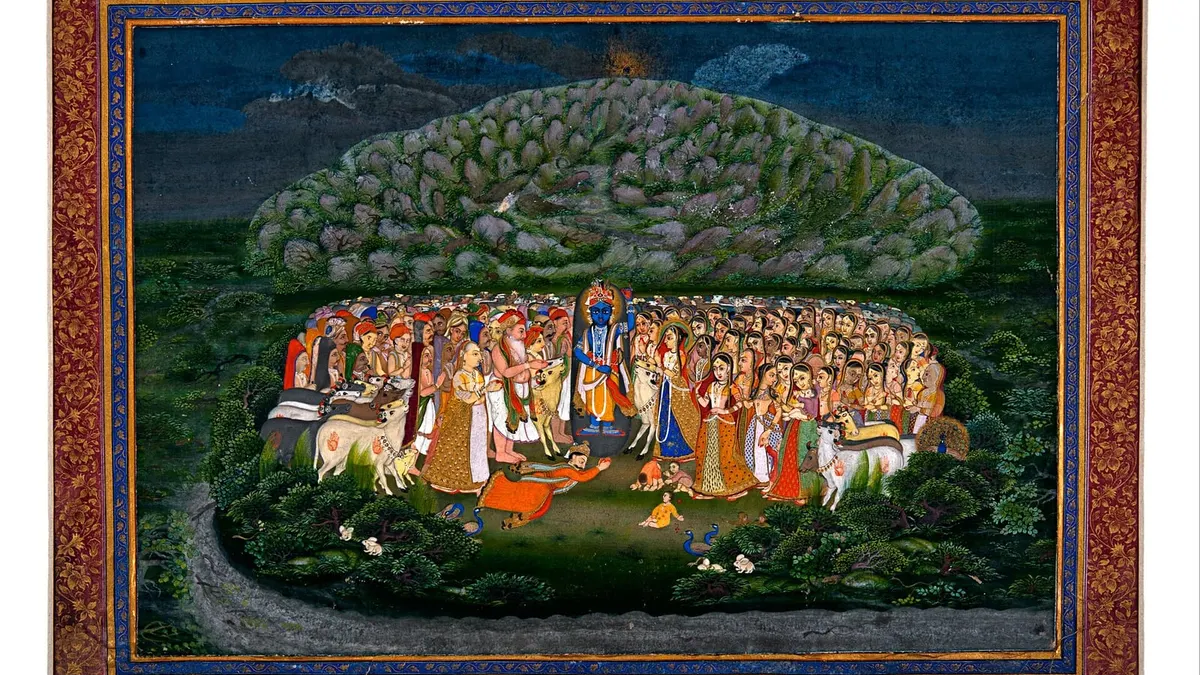
A retelling in our own words, from the Srimad Bhagavatam, Canto 10, Chapters 24 and 25. It is not a translation.
The whole village of Vraja is getting ready for a big puja. Pots are being filled, sweets are being made, and the elders are talking about the arrangements. Krishna, still a boy, walks up to his father Nanda and asks a simple question.
"What is all this for?"
Nanda explains. Every year the cowherds worship Indra, the king of the gods, because Indra sends the rain. Rain makes the grass grow. Grass feeds the cows. The cows feed all of us.
Krishna is not convinced. He gives his father a long answer, and the short version goes like this. We are cowherds. We live by the cows, the forest and this hill. Every creature gets what its own actions bring. So why not worship what is right in front of us: the cows, the brahmanas, and Govardhan Hill?
The elders of Vraja hear him out. And they agree.
A feast for a hill
So the same food goes to a different place. The villagers cook mountains of it and offer it all to Govardhan. They walk around the hill with their cows, singing.
Then something strange happens. Krishna takes on a huge form and says, "I am Govardhan," and the hill eats the offerings. At the same time the boy Krishna stands among the villagers and bows to that form along with everyone else. The Bhagavatam tells it with a straight face. We always laugh at this part.
Indra loses his temper
Up in heaven, Indra is not laughing. A village of cowherds has cancelled his puja because a child told them to.
He sends the clouds that are meant for the end of the world. The rain comes down in sheets. Hail, thunder, and a wind that knocks over the calves. The cows shiver and the people of Vraja run to the one person they trust.
"Krishna, save us."
Krishna looks at the storm and understands exactly who sent it. He walks up to Govardhan Hill and lifts it with one hand. The Bhagavatam compares it to a child picking up a mushroom.
He holds it up like an umbrella and calls everyone in: his mother, his father, the whole village, with their cows. They come with their carts and their belongings. There is room for all of it.
Seven days
The rain does not stop for seven days. For seven days Krishna stands there, holding the hill. He does not eat or drink, and he does not move from the spot. We like to picture the people under the hill, a week of rain outside, and nobody able to take their eyes off the boy holding up the roof.
On the eighth day Indra gives up. The clouds go away, the sun comes out, and the villagers walk out with their cows. Krishna puts the hill back exactly where it was.
A couple of chapters later (Chapter 27) Indra comes down, ashamed, to apologise. That is a story of its own.
A boy's question
There are two things we love here.
One is how ordinary the first half is. A boy asks his dad why the family does a puja. Many of us asked our parents that question. Krishna's answer turns the family's attention to the things that actually keep them alive: the cows, the land and the hill.
The other is the picture of the whole village under one roof. Rich and poor, old and young, cows and calves, all in the same dry patch for a week, all looking at the same face. When people ask us what the word "shelter" means in bhakti, we usually just describe this scene.
Govardhan Puja this year
Govardhan Puja falls on Tuesday, 10 November 2026 in India, and Monday, 9 November in Toronto and Vancouver. Families make a hill of food, the annakut, and walk around it, just like the villagers did.
Some kirtans for the day from the site:
- Govardhanastakam (Krsna Prasadena Samasta Saila)
- Giriraja Arati (Jaya Jaya Girirajer Aratika Sobha)
- Govardhana Giri Vare
If the children are around while the annakut is being made, this is a good story to tell them. Let them ask "but why?" as many times as Krishna did.