Nachiketa: the boy who waited three nights at Death's door
नचिकेता: यम के द्वार पर तीन रातें
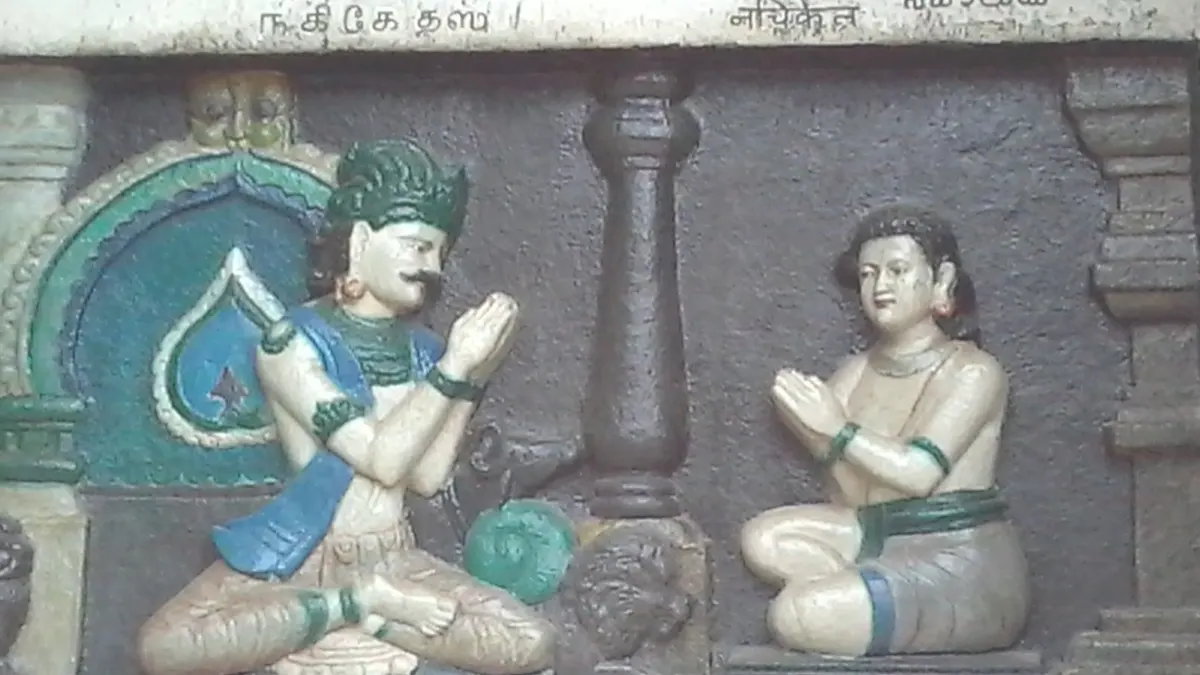
This is a retelling in our own words of the opening story of the Katha Upanishad (Part 1, the first sections). It is not a translation, and we have left Yama's teaching itself to the text.
A father is giving everything away.
His name is Vajashravasa, and he is performing a great sacrifice in which a man gives away all that he owns. The cows are being led out one by one to the priests. His young son Nachiketa is watching.
And Nachiketa notices something. These cows are old. They have drunk their last water and eaten their last grass. They will give no more milk and no more calves. His father is giving away what he no longer needs and calling it everything.
The boy is not angry. He is worried. A gift like this cannot bring anything good to his father. So he walks up and asks a question.
"Father, to whom will you give me?"
His father ignores him. He asks again. And a third time.
His father snaps. "To Death I give you."
The walk to Yama's house
Nachiketa takes his father at his word. The Upanishad lets us hear him think it through: many have gone before me, many will go after. People ripen like grain, fall, and come up again. So he goes to the house of Yama, the god of death.
Yama is not home.
Nachiketa waits at the door. One night. Two. Three. No one offers him food, water or a seat.
When Yama comes back, his household is alarmed. A brahmana guest has been left at the door for three nights without even a glass of water. In that world, that was a serious failure. Yama hurries out, bows to the boy, and offers him three boons, one for each night.
Three boons
The first boon is about his father. Nachiketa asks that his father be calm again, not angry with him, and that he recognise his son and welcome him when he returns home. Yama agrees at once.
The second is about the fire ritual that leads to the heavenly world. Yama explains it, and Nachiketa repeats it back to him correctly. Yama is so pleased that he throws in an extra gift: from now on, that fire will be called by Nachiketa's name. He also gives him a chain of many colours.
The third boon is the real question. When a person dies, some say he still exists. Others say he does not. Which is it? Teach me that.
The offer
Yama does not want to answer. Even the gods have had this doubt, he says. It is subtle. Ask me something else.
Nachiketa will not.
So Yama tries to buy him off. Sons and grandsons who live for a hundred years. Herds of cattle, elephants, gold, horses. Land as far as he can see, and as many years of life as he wants. Beautiful women with chariots and music, the kind no ordinary man could ever have.
Take all of it, Yama says. Just don't ask me about death.
The boy's answer is calm. All of these things last until tomorrow. They wear out the senses. Even the longest life is short. Keep your horses, your dancing and your songs. Wealth has never satisfied anyone. I will ask for this one thing and nothing else.
The test is over
This is where Yama changes. He tells Nachiketa that there are two paths in front of every person: the good, and the pleasant. Most people pick the pleasant. Nachiketa, offered the whole world, picked the good.
And then Death begins to teach him. That teaching fills the rest of the Upanishad. We won't paraphrase it here. It deserves a careful reading in a good translation, ideally with a teacher.
The bribe he turned down
We first heard this one as teenagers, and the part that stuck was not the philosophy. It was the boy who would not take the bribe.
Picture it as an offer on your phone. Unlimited everything, a hundred years of it, as long as you stop asking the one question that keeps you up at night. Most of us would at least think about it.
Nachiketa did not. And there is something else we notice now that we are older. His first boon was not for himself. Standing at Death's door, after three hungry nights, the first thing he asked for was that his father would not be angry anymore.
About this retelling: the source is the Katha Upanishad, Part 1 (the first adhyaya), which begins with this story. The same story is also told in an older form in the Taittiriya Brahmana.