Savitri walks behind Yama, and will not turn back
सावित्री और यमराज: जो पीछे नहीं लौटी
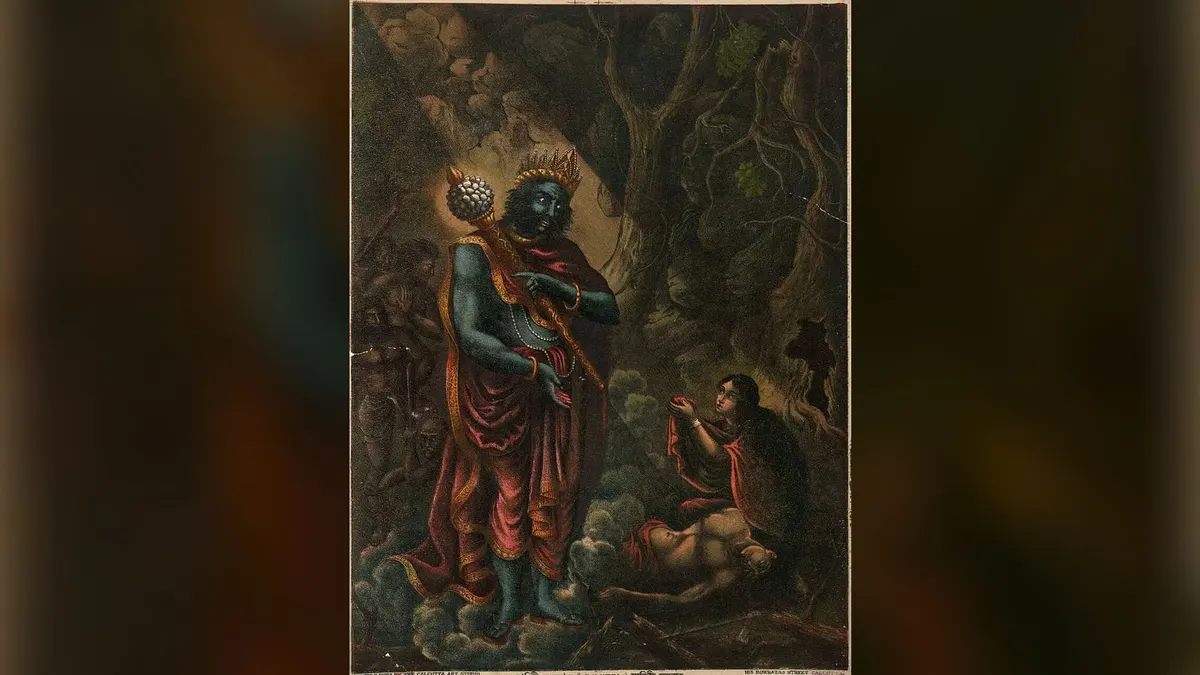
Savitri has known the date for a year.
She knew it before her wedding. The sage Narada told her father and her, plainly: the young man she has chosen is good, generous, truthful and handsome, and he will die exactly one year from today. Her father begged her to choose someone else. She said she had chosen once, and that was that.
Now the year is almost over.
Who she was
Savitri was the daughter of Ashvapati, king of Madra. He had no children for a long time and prayed to the goddess Savitri for eighteen years. When his daughter was born he named her after the goddess.
She grew up so radiant that no prince dared to ask for her hand. So her father told her to go out and find a husband herself.
She came back having chosen Satyavan. He was the son of Dyumatsena, a king who had gone blind, lost his kingdom to an enemy and now lived in a forest hermitage with his wife and son. Satyavan cut wood and gathered fruit for his parents.
That was when Narada gave his warning.
The year
Savitri married Satyavan and moved into the forest. She took off her jewels, wore bark cloth like the family, and looked after her blind father-in-law and her mother-in-law. Everyone loved her.
She never stopped counting the days.
Four days before the date, she began a fast: three days and nights, standing, without food. Her in-laws were worried and tried to stop her. She would not stop.
On the last morning, Satyavan picked up his axe to go into the forest for firewood. Savitri asked to come along. She had never asked before.
The forest
Satyavan was splitting wood when his head began to ache. He lay down with his head in her lap.
Then she saw him. A figure in red, dark-skinned, with a noose in his hand, standing over her husband. She laid Satyavan's head down gently, stood up and asked who he was.
It was Yama. He had come himself, he said, because Satyavan was a man of real goodness. He drew Satyavan's life out with his noose and set off south.
Savitri followed.
The conversation
Yama told her to go back and perform the funeral rites. She kept walking. And as she walked, she talked to him about dharma: about how walking even a few steps together makes people friends, and about what the good owe each other.
Yama was pleased. He offered her a boon, anything except her husband's life. She asked for her father-in-law's sight. Granted. Go home now.
She kept walking, and kept talking. A second boon: Dyumatsena's kingdom back. Granted. A third: a hundred sons for her own father, who had no son. Granted.
Then a fourth boon, again anything but Satyavan's life. Savitri asked for a hundred sons of her own, born to her and Satyavan. Granted.
And still she walked behind him, still talking about the good and the true, until Yama, more pleased than ever, offered her one more boon with no conditions at all.
Now she asked for Satyavan. Without him, she pointed out, the boon he had just given her could never come true.
Yama loosened his noose and let Satyavan go, and promised him four hundred years of life.
She went back to the tree where she had left his body. Satyavan woke up, embarrassed that he had slept so long, and they walked home in the dark. Waiting for them were his parents, his father able to see again, and soon the news that their kingdom was theirs once more.
A year with the date in her head
Most stories about death are about losing an argument with it. This one is about a woman who did not lose, and she did not win by force. She won by staying calm, being kind, knowing her dharma better than anyone expected, and asking for exactly the right thing.
We also love that she knew. She spent a whole year with the date in her head and still lived it fully, caring for her new family, without telling anyone.
Many women keep the Vat Savitri vrat (and in western India, Vat Purnima) in her memory, praying for their husbands and tying threads around a banyan tree. The banyan and the details of that puja come from later practice; the Mahabharata chapter itself does not describe them.
About this retelling: this is our own telling, not a translation. The source is the Mahabharata, Vana Parva (Aranyaka Parva), the Pativrata-mahatmya Parva, where the sage Markandeya tells the story to Yudhishthira (Sections 292 to 298 in K. M. Ganguli's English translation).