Shabari: the old woman who waited for Rama
शबरी: जिसने राम की प्रतीक्षा में जीवन बिता दिया
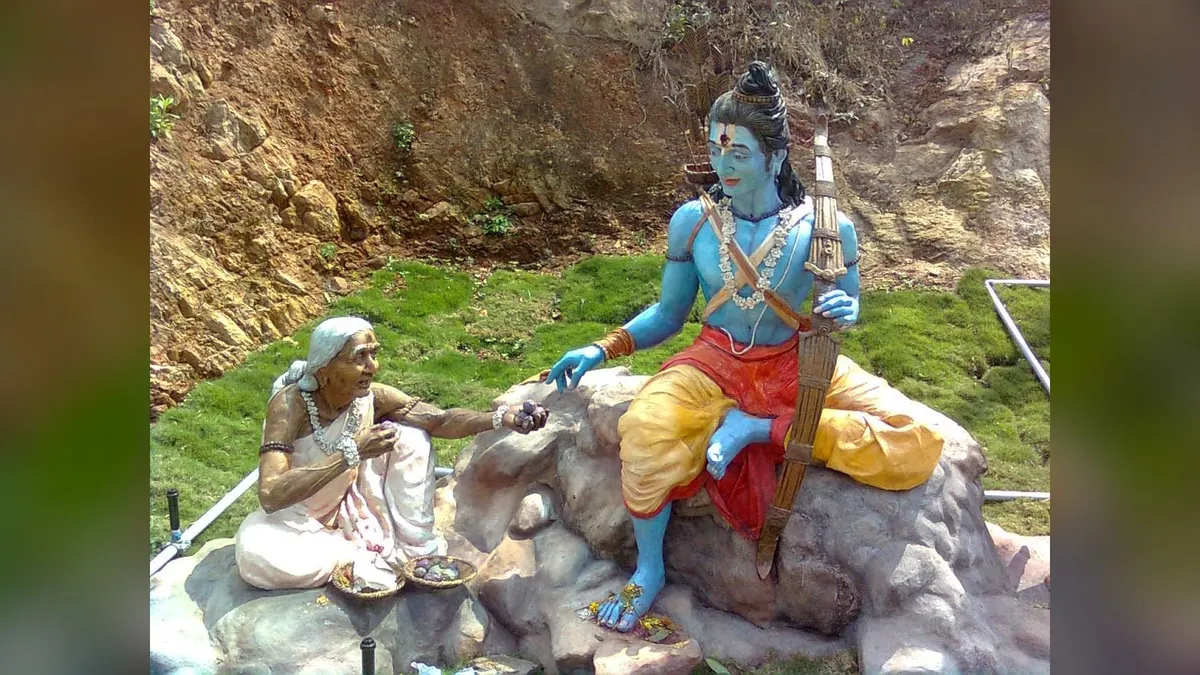
Rama and Lakshmana are walking west, towards Lake Pampa. Sita has been taken. They have been searching the forest for days, and they are tired in the way that only grief makes you tired.
A little earlier, a strange being called Kabandha, freed from a curse by the brothers, had given them directions. Go to Pampa, he said. Find Sugriva, the exiled monkey king. And on the way, at the hermitage of the sage Matanga, there is a woman called Shabari. She has been waiting for you.
The hermitage
Matanga's hermitage is quiet. The sages who used to live there are long gone. Shabari stayed.
She was their student, a woman of the forest who had given her life to their service. When her teachers were leaving this world, they told her one thing: Rama will come here. Wait for him.
So she waited. Years of it. Sweeping the paths, keeping the place ready, going down to the banks of the Pampa to gather forest fruits, just in case today was the day.
We do not know how long it was. Valmiki does not count the years for us, and maybe that is the point. She did not count them either.
Now, at last, two young men in bark clothes walk in through the trees, and she knows.
The visit
Shabari is old. Valmiki describes her as an ascetic woman of great discipline. She gets up as fast as she can, folds her hands, and falls at their feet. Then she does what any of our grandmothers would do when someone they love comes home. She offers them food: fruits she gathered herself from the Pampa's banks, kept ready for this guest.
Rama asks about her, gently. Has her practice gone well, he wants to know, and has she found peace here?
She tells him that seeing him has made her life complete. Then she shows the brothers around the hermitage, the forest where her teachers lived, and the altar where they used to worship.
Here the story turns. Shabari asks Rama's permission to leave her body, now that she has seen him. With his leave she enters a fire and rises to the higher worlds, shining, to join the teachers she served.
Rama turns to Lakshmana. They have seen something wonderful, he says. And they walk on to Pampa, a little lighter, towards Sugriva and Hanuman and everything that comes next.
A note about the berries
You probably know this story with one more detail: Shabari tasting each berry before she offers it, so that Rama gets only the sweet ones, and Rama eating them happily. It is one of the most loved images in all of Indian devotion.
That detail is not in Valmiki's Ramayana. In Valmiki, she offers fruits she gathered for him, and that is all. The tasted berries come from later devotional retellings and folk tradition. We love that version too. We just want you to know where it comes from.
A place kept ready
Most of the Ramayana is full of kings, armies and great vows. Shabari had none of that. As far as we know she never went far from that hermitage, and she never went looking for Rama. He came to her.
What she had was patience, and a place kept ready.
We think about her whenever we light a lamp and nothing seems to happen. The waiting is part of it. One day someone walks in through the trees.
If you want to sing to Rama this evening, try Shri Ramchandra Kripalu, or look through the Rama page for prayers and kirtans. Rama Navami is the big festival for him in spring.
About this retelling: it is our own telling, not a translation. The source is the Valmiki Ramayana, Aranya Kanda, in its last chapters (the meeting with Kabandha and then Shabari at Matanga's hermitage).