Somnath: the first Jyotirlinga, the temple that kept being rebuilt, and the arrow pillar facing the South Pole
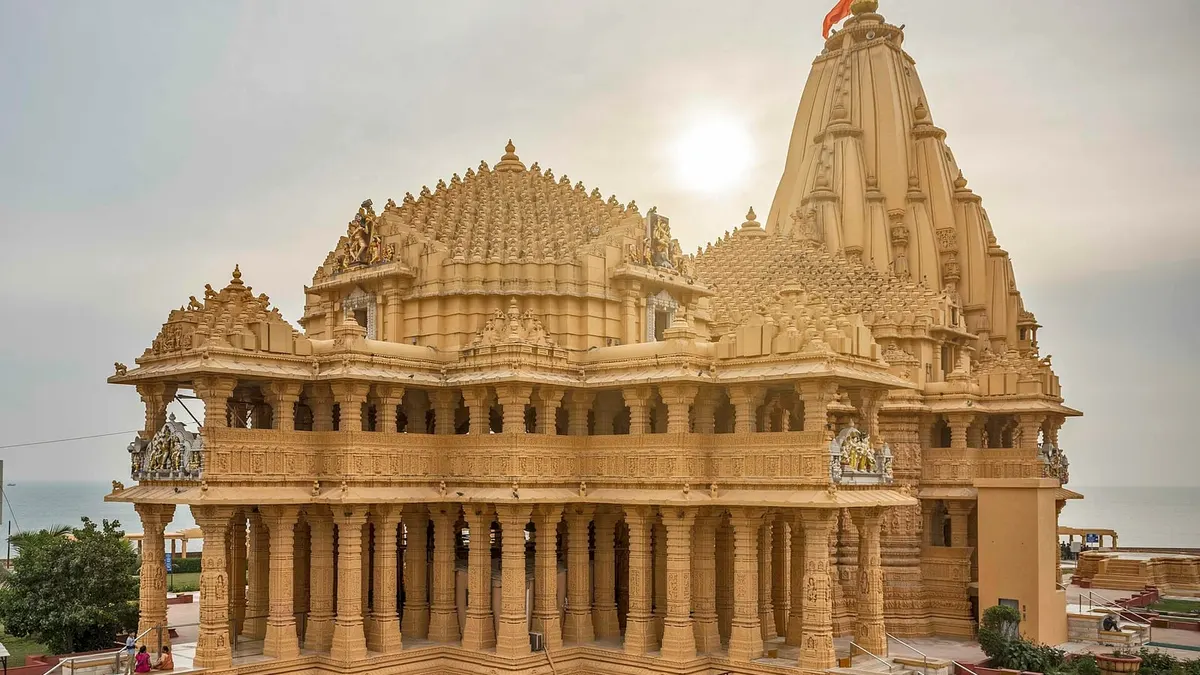
The sea at Somnath is loud. You hear it before you see it, from the temple courtyard, a steady roar against the rocks below the wall. At seven in the evening the aarti begins, the conches and drums join in, and for a few minutes it sounds as if the temple and the ocean are answering each other. Then the bells stop, and the sea goes on.
The story of the place
The temple's tradition, told in the Prabhas Khanda of the Skanda Purana and in the Shiva Purana, is about the Moon. Soma (Chandra) married the twenty-seven daughters of Daksha, the nakshatras, but loved only one of them, Rohini. Daksha, angry for his neglected daughters, cursed Soma to waste away. The Moon came to Prabhas, on this shore, and worshipped Shiva, who softened the curse: Soma would wane and wax by turns. Shiva stayed here as Somanatha, "Lord of the Moon". That is why the tradition counts Somnath first among the twelve Jyotirlingas.
Prabhas is also where, in the Mahabharata and Bhagavata tradition, Krishna's earthly life ended. At Bhalka Tirth, about five kilometres away, a hunter's arrow struck Krishna's foot as he rested under a tree, and at Dehotsarg, near the Triveni Sangam, the tradition places his departure.
The temple that kept coming back
Somnath's history is one of destruction and rebuilding. The temple was sacked by Mahmud of Ghazni in 1026 and attacked several more times over the centuries, and each time it was rebuilt. The present temple was begun after Independence on the initiative of Sardar Vallabhbhai Patel and consecrated in 1951 in the presence of President Rajendra Prasad. It is built in the Chalukya (Solanki) style, in sandstone, with a tall carved spire topped by a flag. It is managed by the Shree Somnath Trust.
What devotees pray for here
Because of the Moon's story, Somnath is a place people come to for healing and for relief from a long decline, in health, in work, in a family's fortunes. Many pray here for peace of mind, an old association with the Moon. Pilgrims also perform rites for their ancestors at the Triveni Sangam nearby. These are traditions of faith; nobody can promise an outcome, and the temple does not.
How darshan works
- Hours: the temple is open from about 6 a.m. to 10 p.m.; last darshan is a little earlier.
- Aartis: three a day, at about 7 a.m., noon and 7 p.m. The evening aarti is the most crowded and the most moving.
- Phones and bags: mobile phones, cameras and other electronics are not allowed in the premises. Deposit them, with large bags, at the cloakroom outside.
- Pujas: abhishek and other pujas are booked through the Shree Somnath Trust's official website or at the temple office.
- Light and sound show: in the evening, after the aarti, a sound-and-light show on the temple's history is held in the courtyard facing the sea. Tickets are sold at the temple.
Kartik Purnima at Somnath
Kartik Purnima, Tuesday 24 November 2026 (India, IST), is one of the temple's big days. A fair is held near the temple around the full moon, and pilgrims take a dip at the Triveni Sangam in the morning before darshan. Expect crowds and plan to stay in Veraval or Somnath the night before.
A half-day around Prabhas
Somnath is more than one temple. A plan that fits into a morning or an afternoon:
- Triveni Sangam, where the Hiran, the Kapila and the hidden Saraswati are said to meet the sea. Pilgrims bathe and perform rites for their ancestors here.
- Dehotsarg, close by, the place the tradition links with Krishna's departure.
- Bhalka Tirth, about five kilometres from the temple, where the hunter's arrow is said to have struck Krishna.
- The old Somnath temple near the main one, built by Rani Ahilyabai Holkar, who also built the present temple at Kashi.
- Back at the main temple for the evening aarti and the sea wall at sunset.
Autos wait near the temple and will do the round for an agreed price.
The best season
October to March is the best time: cool, clear and pleasant by the sea. Mahashivaratri and the Mondays of Shravan are the busiest days. Summers are hot and humid; the monsoon makes the sea rough and the views dramatic.
How to reach
The nearest railway station is Veraval, about 6 kilometres away, with trains from Ahmedabad, Rajkot and other cities; Somnath has its own small station too. The nearest airports are Diu (about 80 kilometres) and Rajkot (about 190 kilometres). Many pilgrims combine Somnath with Dwarka, about 230 kilometres up the coast, and with Gir National Park.
A detail most visitors miss
On the sea wall of the temple stands a small pillar with an arrow on top, the Baan Stambh. Its inscription says, in Sanskrit, that in the direction the arrow points, there is no land between this shore and the South Pole, only unbroken sea. Stand beside it, look out over the water, and think of the people who knew that, centuries before anyone had a map to check.
If you can't travel
On a Monday evening, or on Purnima, light a lamp and sing:
- Dvadasha Jyotirlinga Stotram, whose first name is Somanatha
- Shiva Panchakshara Stotram
- Rudrashtakam
- Mahamrityunjaya Mantra
- Om Jai Shiv Omkara
Every page has Read in, so you can read it in Gujarati script if that is easier.