Diwali Lakshmi-Ganesh puja at home, step by step (2026)
दीपावली पर घर में लक्ष्मी-गणेश पूजा, क्रम से (2026)
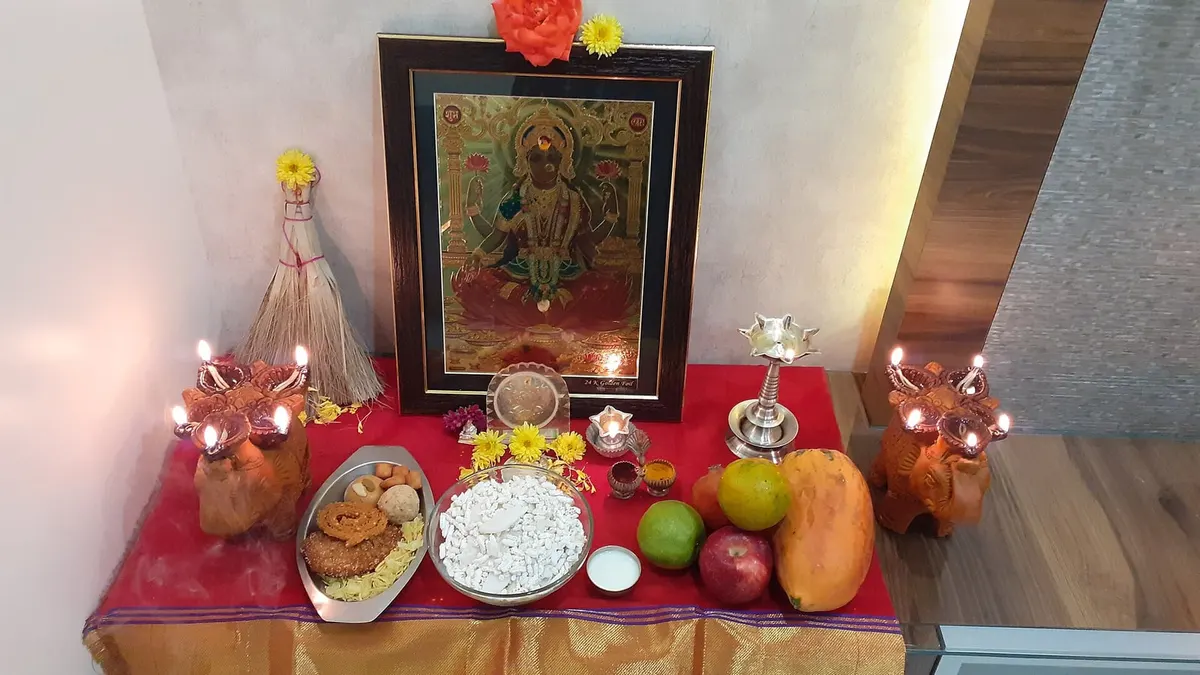
Look at the photo above. A framed Lakshmi, a broom tied with a thread and a flower, puffed rice, a plate of chakli, a papaya, elephant lamps. Nothing on that table is expensive. It looks like a real home on a real Diwali, and that is the kind of puja this guide is for: one you can do with your own family, without a priest, in about forty minutes.
The date and the time
| Place | Diwali (Lakshmi puja) 2026 |
|---|---|
| India (IST) | Sunday, 8 November |
| India, Vaishnava (ISKCON) calendar | Monday, 9 November |
| Toronto and Vancouver | Sunday, 8 November |
The rule. Lakshmi puja is done on the new moon (amavasya) of Kartika, in pradosh kaal, the window of about two and a half hours that starts at sunset. Inside pradosh, many families aim for the slot when Vrishabha lagna is rising, because Vrishabha is a fixed (sthir) sign, and the hope is that Lakshmi, welcomed in a fixed lagna, stays.
New Delhi, 8 November: Drik Panchang and PanchangBodh both give the Vrishabha slot as 5:54 PM to 7:50 PM IST, inside a pradosh that starts at about 5:31 PM. Other Indian cities differ by up to half an hour or more with their sunset. Look up your city, or start soon after your own sunset and you will be inside pradosh.
Toronto and Vancouver: Sunday 8 November is the day in both cities: Drik Panchang gives Lakshmi puja that evening, and Drik Panchang and GCal both give it as the Vaishnava Diwali there too (unlike India, where the Vaishnava day is Monday). We do not give a clock time for North America, because the published times don't agree. Start after your local sunset; the Sandhya times tool on the Nitya Karma page shows it. Elsewhere in North America, ask your local temple.
The Diwali page lets you switch between India, Toronto and Vancouver.
Keep ready (do this in the afternoon)
- A low table or chowki, and a new red or yellow cloth
- A picture or murti of Lakshmi and one of Ganesha (one combined picture is fine)
- A kalash (a lota will do) with water, mango leaves and a coconut on top
- A plate of rice, and a little haldi, kumkum and sandalwood paste
- Flowers, especially lotus or marigold, and a garland if you can
- One large ghee lamp that can burn for hours, plus diyas for the house
- Agarbatti, camphor, a bell, matches
- Naivedya: kheel (puffed rice) and batashe, sweets, seasonal fruit
- A few coins, your Dhanteras purchase, and for business families the account books, a pen and ink
- In some homes, a new broom
- A bowl of water and a spoon for achaman
- Your phone, with the aarti pages saved (tap Save on each) so you can find them in the dark
Before sunset
Bath, clean clothes, a clean house. Draw rangoli at the door; many families add small footprints in rice paste walking in, for Lakshmi. Open the front door and the windows a little. In many homes they stay open through the evening so that Lakshmi can come in.
The puja, in order
Families differ. If yours has its own order, keep it. This is a plain, common sequence.
- Sit down, settle. Face the altar. Sip water three times from your palm (achaman) and sprinkle a little water on yourself and the things on the altar.
- Light the main lamp. This is the lamp that will burn through the evening.
- Sankalpa. Hold a little water, rice and a flower, and say in your own words who you are, the date, and that you are doing this puja for your family. Our Today's Panchang page gives the day's tithi and paksha if you want to include them. Then let the water go onto the plate.
- Kalash. Bow to the kalash, offer a flower and kumkum.
- Ganesha first. Water (a few drops are enough), sandal paste, kumkum, rice, flowers, durva grass if you have it, incense, the lamp, and a sweet.
- Lakshmi. The same offerings: water, sandal, kumkum and haldi, rice, flowers and a garland, incense, lamp. Then the naivedya: kheel and batashe, sweets, fruit. Place the coins and the new vessel in front of her.
- Kubera and the account books. Many families draw a swastika with kumkum on the safe, the cash box or the first page of the new account book, and offer a flower and rice there. In Gujarat this is chopda pujan, with new books for the year.
- The broom, if it is your custom. A dot of haldi and kumkum, a flower, a bow.
- Stotra. If there is time, Shri Suktam, Mahalakshmi Ashtakam or Kanakadhara Stotram. Read them from the page. Older family members who prefer Gujarati, Bengali or Tamil script can tap Read in.
- Aarti. Jai Ganesh Deva first, then Om Jai Lakshmi Mata. Everyone takes the aarti flame with their palms.
- Flowers and a bow. A handful of flowers offered together, then a full bow. Ask forgiveness for anything missed. Every puja has something missed.
- Light the house. Take the flame from the main lamp to the diyas: the door, the windows, the kitchen, the tulsi, the balcony.
- Prasad. Share the kheel and sweets. Then the crackers, if that is your family's thing.
In many homes the big lamp is kept burning all night, and someone checks it before bed. Many families also remember Rama tonight, since Diwali marks his return to Ayodhya; Shri Ramchandra Kripalu is on the site. In Bengal the same night is Kali Puja.
Two small things nobody tells you
Kheel and batashe are not random. They are cheap, white and sweet, and in many north Indian homes there is no Diwali puja without them. Some sweet shops even shape batashe like little animals for children.
The broom in the photo is there on purpose. A new broom is bought at Dhanteras or on Diwali day, and in many homes it is worshipped as a form of Lakshmi, then put away in a clean spot. Ask your grandmother whether yours did this. You may get a story.
The morning after
- Bathe and light a lamp at the altar before anything else.
- Distribute the remaining prasad to neighbours and anyone who works in or for your home.
- The amavasya runs into Monday morning in India, so many families keep the altar as it is until then.
- Sow the Dhanteras dhaniya in a pot if you kept it.
- Burnt-out clay diyas, old flowers and wicks go into a garden, a planter or clean flowing water where that is allowed, not into the bin with the kitchen waste.
- Govardhan Puja comes on Tuesday 10 November in India; see the Govardhan Puja page. Then Bhai Dooj on Wednesday.
In North America
- Your temple may hold its big programme on the weekend; the home puja is still Sunday after sunset.
- Many condos don't allow open flames on balconies. Keep the diyas inside, on steel plates, away from the smoke alarm, and use electric diyas for the balcony and windows.
- No mango leaves? Any clean green leaves on the kalash, or just the coconut.
- No lotus? Any fresh flower. The puja asks for clean and sincere, not rare.
Questions people ask
Can I do Lakshmi puja without a priest? Yes. Most families do. Follow the steps above or your family's own order.
Which comes first, Ganesha or Lakshmi? Ganesha. He is worshipped first at every puja, and his aarti is sung first.
I missed the muhurat. What now? Do the puja as soon as you can that evening. The muhurat is the best time; it isn't the only time.
Diwali on the 8th or the 9th? Sunday 8 November is the general (Smarta) date in India. The Vaishnava (ISKCON) calendar keeps Monday 9 November in India. In Toronto and Vancouver both fall on Sunday 8 November. Follow your temple and your family.
Are electric diyas all right? Yes, where real flames aren't safe or allowed. Keep at least the one main lamp at the altar a real flame if you can.
For the earlier days, read our Dhanteras guide and Narak Chaturdashi guide, and the Diwali week overview for all five days.
Shubh Deepavali.